FROM STRUCTURED DATA TO FASTER DECISIONS: ENABLING CLINICALDECISION SUPPORT ACROSS THE CONTINUUM OF COMBAT CARE
Modern combat casualty care depends on more than clinical expertise alone. Across the continuum of care – from initial treatment through evacuation and onward to Role 3 facilities – medical teams operate under time pressure, constrained resources, and rapidly shifting operational conditions. Clinicians must assess, intervene, document, and communicate simultaneously. In these environments, the structure and usability of clinical information directly influence decision speed and care continuity.
Whether operating in a high-volume military treatment facility, aboard maritime platforms, or in distributed settings with limited connectivity, fragmented workflows and unstructured documentation delay access to critical information.
T6 Health Systems is addressing this challenge by enabling care teams to capture and use structured, actionable clinical data – not as an administrative exercise, but to support real-time clinical decision-making. The approach is grounded in a practical principle: documentation should reinforce care delivery across the continuum, not compete with it.
A PLATFORM BUILT FOR CONTINUITY OF CARE
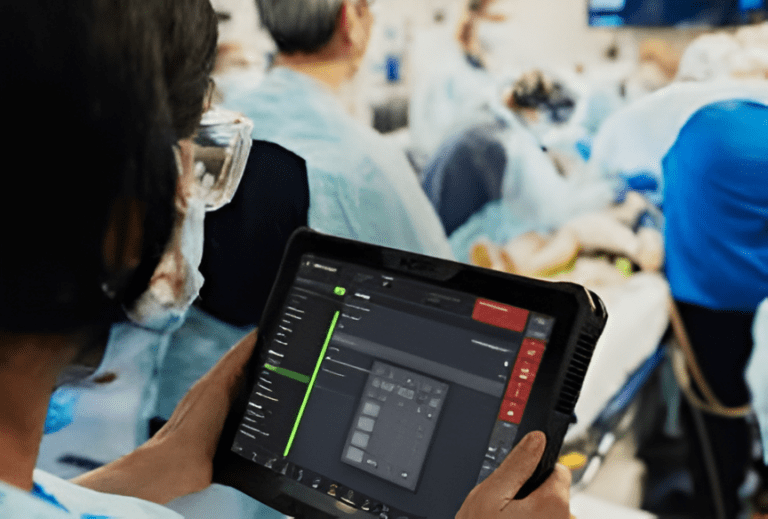
T6 Health Systems delivers a platform designed to support how clinical encounters are documented and communicated across operational settings and echelons of care. For clinicians, this means less time navigating complex templates or re-entering information, and more time focused on assessment, treatment, and coordination.
When documentation is structured and encounter-centric, clinical information becomes easier to access across teams, units and platform supporting continuity as patients move through evacuation chains and
extended treatment pathways.
WHY STRUCTURED DATA MATTERS ACROSS ROLES OF CARE
Operational clinicians are expected to deliver timely, accurate, and fully documented care despite variability in staffing, bandwidth, and operational tempo. Structured documentation helps keep critical clinical information usable as care evolves across locations and roles.
This approach enables several operational advantages:
. Faster clinical decision support by surfacing relevant information in context
. Improved efficiency and streamlined workflows
. Reduced cognitive burden by organizing documentation around the encounter
. Clearer handoffs by preserving key details across transitions The objective is earlier clarity – without slowing providers.
OPERATIONAL USE ACROSS DIVERSE CARE ENVIRONMENTS
Across the military health ecosystem, T6’s recentinitial-phase operational deployments reflect growing demand for systems that perform in real-world conditions and scale across mission sets. Early use environments, including USS Carney, Brooke Army Medical Center, the White House Medical Unit, Al Dhafra Air Base, and USS Kearsarge, share a common requirement: the ability to document care rapidly, maintain continuity, and support clinical decision-making under operational constraints.
When documentation is intuitive, structured, and aligned to clinical workflow, providers spend less effort managing information and more effort managing patient care. Across these settings, structured clinical
capture reduces friction for clinicians while improving the reliability of medical information, an essential foundation for sustaining care across the continuum.
SUPPORTING JOINT READINESS THROUGH JOMIS ALIGNMENT
Momentum behind these efforts is supported by alignment with the Joint Operational Medicine Information Systems (JOMIS) framework, an evolving initiative focused on modernizing operational medical capabilities across the Joint Force. As combatant commands and Services pursue interoperable, mission-ready systems across joint and coalition environments, the ability to capture and transmit structured clinical data in real time has become an operational necessity.
This alignment enables clinical information to move with the patient across roles of care, supporting continuity during evacuation, extended care, and definitive treatment.
SUSTAINING CARE WITH SMARTER CLINICAL SUPPORT
Operational medical teams require tools that keep pace with real-world demands without adding unnecessary complexity. By improving how clinical encounters are captured and translated into structured, usable insight, T6 is helping reduce documentation burden, strengthen transitions of care, and support faster decision-making across the continuum of combat care.
Systems that preserve clinical intent over time are not administrative conveniences; they are essential enablers of effective care wherever the mission demands.
